
White noise helps babies sleep. But how loud is too loud?
Can it harm your baby's hearing?
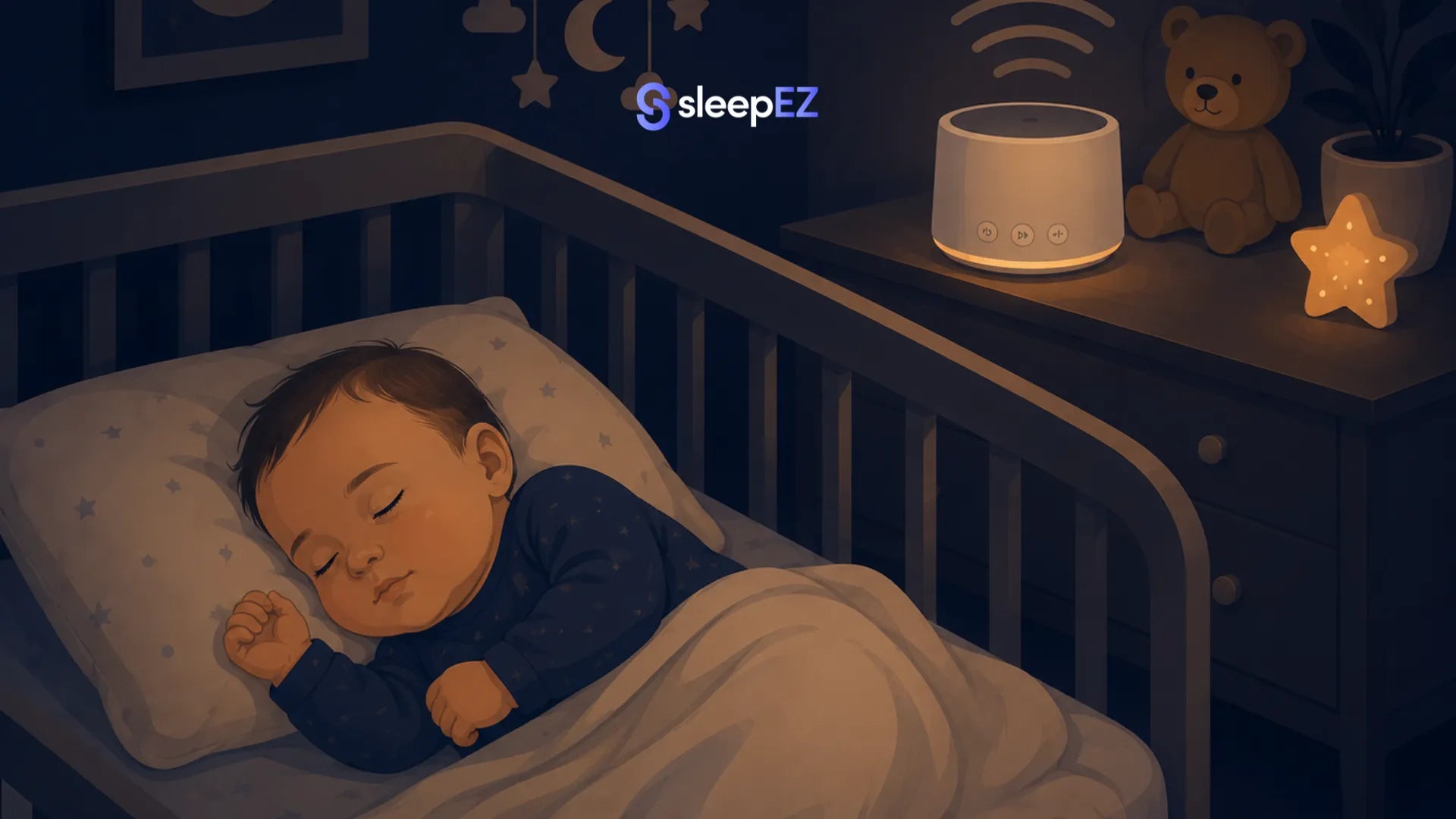
There is a safe decibel range recommended by pediatric experts. Many sound machines exceed it if placed too close or on high volume.
This guide explains exactly what level is safe, backed by AAP and WHO guidelines, and how to test it at home.
Quick Answer: How Loud Should a Baby Sound Machine Be?
Most paediatric experts recommend keeping baby sound machines below 50 decibels (dB) when measured at your baby's crib. This is roughly the volume of a quiet conversation or a gentle shower running in another room.
Key rules:
- Keep volume below 50 dB at crib level (use a free decibel app to check)
- Place the machine at least 2 metres (6–7 feet) away from the crib
- Use white, pink, or brown noise, avoid music with melody or variable sounds
- Safe for continuous overnight use at or below 50 dB
Why 50 dB Is the Recommended Limit
The 50 dB guideline comes from the American Academy of Pediatrics (AAP), which recommends this as the safe upper limit for infant sound exposure during sleep.
Why babies are more sensitive than adults:
- The cochlea (inner ear hearing organ) is still developing in the first two years of life
- Prolonged exposure to loud noise can cause permanent hearing threshold shifts
- Babies cannot tell you when something is too loud, they rely on you to monitor it
What the research shows:
A 2014 study in Pediatrics examined 14 popular infant sound machines. All of them exceeded 50 dB when placed at typical close distances.
Some reached above 85 dB at maximum volume, a level the WHO identifies as a hearing damage risk with prolonged exposure.
The good news: at the right volume and distance, white noise is safe and can actually improve sleep quality by masking disruptive household sounds.
How Loud Is 50 dB? Real-Life Examples
Most people don't have an intuitive sense of what 50 dB sounds like. Here are real-world comparisons:
| Sound | Approximate dB Level |
|---|---|
| Whisper | 30 dB |
| Quiet library | 40 dB |
| Refrigerator hum | 45 dB |
| 50 dB, recommended maximum | Quiet office, soft rainfall |
| Normal conversation | 60 dB |
| Vacuum cleaner | 70 dB |
| Hair dryer | 85 dB |
At 50 dB, the sound should feel like gentle background noise, present but not intrusive. If you walk into the room and the sound machine is the first thing you notice, it's probably too loud.
Best Volume for Newborns vs Older Babies
Younger babies may benefit from slightly lower volumes, as their hearing is more sensitive in the early weeks.
| Age | Recommended Volume at Crib Level |
|---|---|
| Newborn (0–3 months) | 40–45 dB |
| 3–12 months | 45–50 dB |
| Toddler (12+ months) | Up to 50 dB |
Newborns are accustomed to womb sounds, which measure around 50 dB, so white noise is naturally familiar and comforting. Starting slightly lower and adjusting as needed is a sensible approach.
What's the Safe Decibel Range for Babies?
The American Academy of Pediatrics recommends keeping infant sound machines below 50 decibels when measured at crib level to protect developing hearing.
Safe Volume Levels:
- Under 50 dB: Safe for newborns and infants (AAP recommended)
- 50-60 dB: Acceptable for short periods (naps under 2 hours)
- 70 dB+: Too loud and potentially risky
- 85 dB+: Harmful for prolonged exposure (WHO threshold for hearing damage)
Sound Level Comparison
| Sound Level | Example | Measured Distance | Safe for Babies? | Duration Guideline |
|---|---|---|---|---|
| 30 dB | Whisper | 3 feet | ✅ Yes | Unlimited |
| 40 dB | Library | 3 feet | ✅ Yes | Unlimited |
| 50 dB | Quiet office | 3 feet | ✅ Yes | Up to 24 hours |
| 60 dB | Normal conversation | 3 feet | ⚠️ Short only | Maximum 8 hours |
| 70 dB | Vacuum cleaner | 3 feet | ❌ No | Risk after 2 hours |
| 80-85 dB | Hair dryer | 3 feet | ❌ Dangerous | Risk after 15 minutes |
Duration Guidelines: How Long Is Safe?
Volume matters. So does exposure time.
Safe Duration at Different Volumes:
- 50 dB or below: Safe for continuous use (8-12 hours overnight)
- 50-55 dB: Safe for up to 8 hours
- 55-60 dB: Maximum 2-4 hours (naps only)
- 60+ dB: Not recommended for infant sleep environments
According to WHO environmental noise guidelines, continuous exposure above 65 dB during sleep hours can interfere with healthy development and sleep quality.
Most pediatricians agree that running a sound machine at 50 dB throughout the night is safe. It can actually improve sleep quality by masking disruptive household noises.
Why Volume Matters: Baby Hearing Sensitivity Explained
Infant ears are more sensitive than adult ears. The cochlea (inner ear hearing organ) is still developing in the first 2 years.
Prolonged loud noise can cause permanent hearing threshold shifts. Loud white noise can also mask important cues like crying, stirring, or breathing changes.
A 2014 study in Pediatrics examined 14 popular infant sound machines. All of them exceeded 50 dB when placed at typical distances. Some reached hazardous levels above 85 dB at maximum volume.
Key point: Babies don't need loud noise to sleep. They need consistent, gentle background sound that mimics the womb environment (about 50 dB).
Read: White Noise Machine For Baby
How to Measure the Volume of Your Baby's Sound Machine
You need simple, practical steps to test your setup.
Option 1: Using a Phone App (Most Accurate)
Recommended Apps:
- iOS: "Decibel X", "NIOSH Sound Level Meter" (free, developed by CDC)
- Android: "Sound Meter", "Decibel X"
Steps:
- Download a decibel meter app
- Place phone at crib mattress level (baby's ear height), not next to the machine
- Turn on sound machine at your typical volume
- Check decibel reading. Aim for 45-50 dB
- Adjust volume and distance until you reach safe range
Most smartphone apps are within ±2 dB of professional meters for this purpose.
Option 2: The "Arm's Length" Test
This is a quick, no-tech method.
Stand where your baby sleeps. If you need to raise your voice to talk over the sound, it's too loud. If it sounds louder than a quiet conversation, it's too loud for baby.
Option 3: Compare to Real-Life Volumes
Sound comparison guide:
Sounds like: Gentle humming refrigerator, soft rainfall, quiet fan
Sounds like: Running shower, vacuum cleaner, hairdryer
How to Check If Your Baby's Room Is Too Loud
You don't need expensive equipment. Use this simple checklist:
- ☐ You can hear the sound machine clearly from the hallway with the door closed
- ☐ You need to raise your voice to speak normally in the room
- ☐ The machine is placed within 1 metre of the crib
- ☐ The volume is set above the halfway mark on the machine
- ☐ The sound feels loud when you stand at the crib
If any of these apply, your setup may be too loud. Move the machine further away, reduce the volume, and re-test with a free decibel app.
Proper Distance Matters as Much as Volume
Where you place the sound machine affects how loud it is at your baby's ears.
Safe Placement Rules (AAP-Aligned)
Do:
- Place 2+ meters (6-7 feet) minimum from crib
- Position at or below crib height
- Angle sound toward middle of room, not directly at baby
- Keep device on stable surface (dresser, shelf)
Don't:
- Never place inside or on the crib rails
- Never place under crib mattress
- Never cover device with blankets or pillows
- Never place on soft surfaces that could block vents
Distance Impact Example
The same machine at different distances produces very different volumes:
- Sound machine at 3 feet: 65 dB (too loud)
- Same machine at 7 feet: 48 dB (safe)
Can White Noise Be Too Quiet?
Yes. If the volume is too low, white noise won't effectively mask disruptive sounds, which defeats the purpose.
The ideal range is 45–50 dB at crib level. Below 40 dB, the sound may not be consistent enough to mask sudden noises like a door closing or a dog barking.
If your baby is still waking from household sounds despite using a sound machine, the volume may be too low rather than too high. Use a decibel app to check and adjust accordingly.
The Best Sound Types for Safe Baby Sleep
Not all sounds are created equal. Some are safer and more effective than others.
Approved Sounds (Research-Backed)
- White noise (all frequencies equally)
- Pink noise (lower frequencies, similar to rain)
- Brown noise (even lower, like wind)
- Fan sounds (consistent mechanical hum)
- Womb sounds (heartbeat + whooshing)
These work because they mask disruptive sounds without being stimulating.
Avoid These Sounds
- High-pitched tones (can be more damaging to developing ears)
- Intermittent or looping sounds (prevent deep sleep cycles)
- Rainstorms with thunder (startling)
- Music with melody (cognitively stimulating, not restful)
- Ocean waves with crashing (variable volume)
Signs Your Baby's Sound Machine May Be Too Loud
Watch for these warning signs:
- Baby startles easily when sound machine is on
- You can hear sound clearly in hallway with door closed
- Baby is restless, squirmy, or waking more frequently
- Machine is placed within 3 feet of crib at high volume
- You have to raise your voice to be heard in the room
- Baby covers ears or turns head away
General rule: If it sounds loud to you standing at the crib, it's too loud for your baby.
Trust your instincts. Parental intuition about volume is usually accurate.
Choosing a Baby Sound Machine With Safe Volume Control
Not all sound machines are created equal. When choosing one for your baby, look for:
- Adjustable volume with clear increments, so you can set it precisely
- Continuous play mode, loops without stopping or changing volume
- Multiple sound options, white noise, pink noise, and brown noise at minimum
- Timer function, useful for naps (though many parents prefer continuous overnight use)
- Compact design, easier to position at the recommended distance
The Hush Sound Machine
The Hush Sound Machine is designed for baby and children's sleep environments. It offers multiple sound options, adjustable volume, and a compact design that's easy to position safely at the recommended distance from the crib.

Recommended for this guide
Hush Light & Sound Machine
34 soothing sounds and a soft night-light glow, built for baby and kids' rooms with adjustable volume that's easy to keep in the safe range this guide covers.
Your Top Sound Machine Questions Answered
Is 60 dB too loud for a baby?
Yes, for overnight sleep. 60 dB is acceptable for short naps (under 2 hours), but the AAP recommends staying below 50 dB for continuous overnight use. At 60 dB, prolonged exposure may interfere with healthy hearing development.
Is 70 dB dangerous for babies?
Yes. 70 dB exceeds the recommended safe limit for infant sleep environments. At this level, the risk of hearing impact increases with duration of exposure.
Move the machine further away and reduce the volume immediately.
Is 50 dB too loud for a newborn?
50 dB is the recommended upper limit, even for newborns. For very young babies (0–3 months), starting at 40–45 dB is a more conservative approach.
Newborns are accustomed to womb sounds of approximately 50 dB, so this level is generally considered safe.
Should a sound machine run all night?
Yes, at safe volumes (below 50 dB) and proper distance (2+ metres from crib), continuous overnight use is considered safe by most paediatric experts. Consistent sound throughout the night can actually help babies link sleep cycles without waking.
Can white noise damage hearing?
Only if used at excessive volumes (70+ dB) or placed too close to the baby. At the recommended 50 dB or below, at the recommended 2-metre distance, white noise does not damage hearing.
How do I measure my baby's sound machine?
Download a free decibel meter app (iOS: NIOSH Sound Level Meter or Decibel X; Android: Sound Meter or Decibel X). Place your phone at crib mattress level, not next to the machine, and check the reading. Aim for 45–50 dB.
Can white noise damage my baby's hearing?
When used correctly (under 50 dB, placed 6+ feet away), white noise is safe. It will not damage hearing.
The risk comes only from excessive volume (70+ dB) or placement too close to baby's ears. The 2014 Pediatrics study found risks only when machines were used at maximum volume or placed too close.
How far should a sound machine be from the crib?
The American Academy of Pediatrics recommends placing sound machines at least 6-7 feet (2+ meters) away from the crib.
This distance significantly reduces decibel exposure while still providing effective sound masking.
What volume should a baby sound machine be?
Keep your baby's sound machine below 50 decibels when measured at crib level.
This is roughly the volume of a quiet conversation or a soft shower running in another room. Use a smartphone decibel app to measure accurately.
Can I use a sound machine all night for my baby?
Yes. Continuous use at or below 50 dB is considered safe for overnight sleep (8-12 hours).
Many pediatricians recommend consistent white noise throughout the night to help babies link sleep cycles.
Are white noise machines safe for newborns?
Yes, when used at safe volumes (under 50 dB) and proper distances (6+ feet away).
Newborns are actually used to womb sounds, which measure around 50 dB. This makes white noise naturally comforting.
Final Thoughts
White noise is safe for babies. But only at the right volume and distance.
When used according to AAP guidelines, sound machines can be a valuable tool for better infant sleep without any risk to hearing development.
Remember this rule: Keep it under 50 dB, place it 6+ feet from the crib, and always test the sound from your baby's ear level using a free decibel app.
You now have the expert-backed knowledge to use white noise safely and confidently. Trust the guidelines, test your setup, and enjoy those longer stretches of sleep.
Quick Reference Checklist
Print this and check your setup today:
- [ ] Sound machine measures under 50 dB at crib level
- [ ] Machine is at least 6-7 feet from crib
- [ ] Volume tested with smartphone decibel app
- [ ] Sound type is white, pink, or brown noise
- [ ] Machine is on stable surface, not in crib
- [ ] You can speak at normal volume over the sound
- [ ] Baby sleeps peacefully without startling


Leave a comment
This site is protected by hCaptcha and the hCaptcha Privacy Policy and Terms of Service apply.